
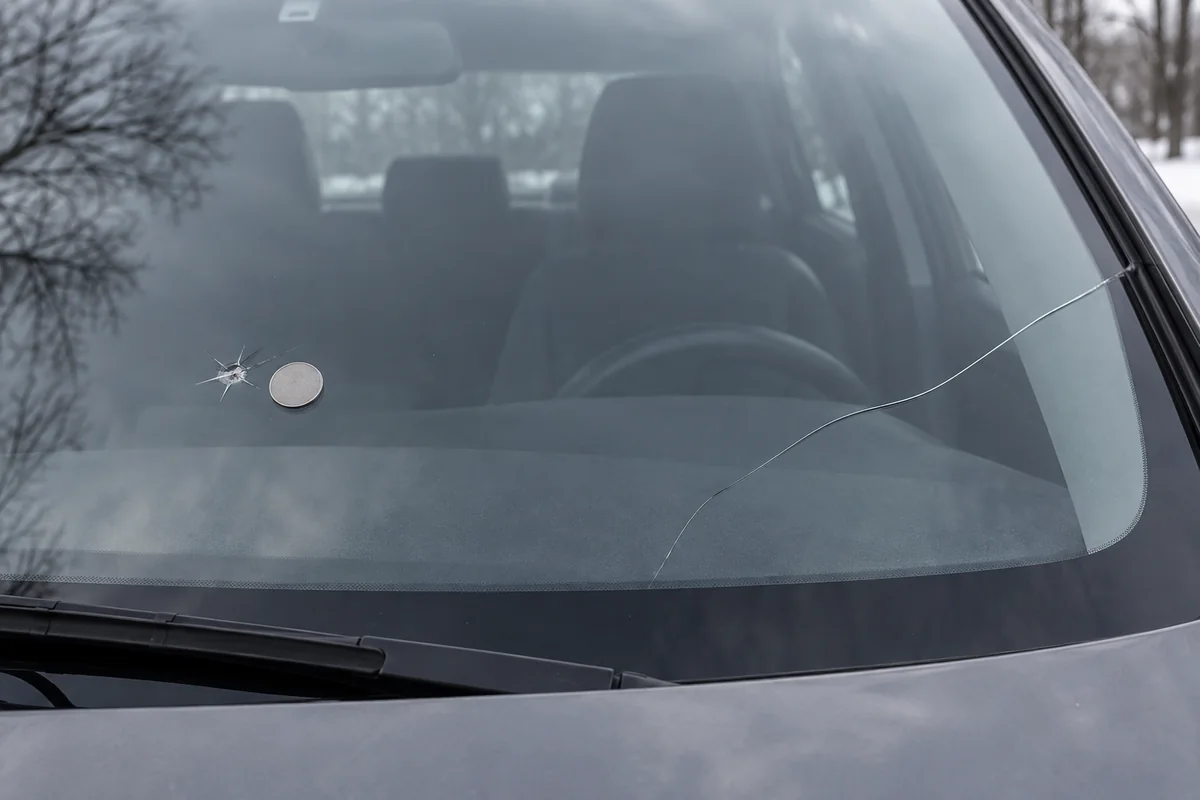
The standard behind the checks
ANSI/AGSC/NWRD ROLAGS 002-2022, the Repair of Laminated Automotive Glass Standard, is the industry's repair rulebook. It is voluntary, not a law, but it is written for repair technicians and it is specific. It tells technicians to inspect damage from both inside and outside the glass before deciding.
Check 1: what kind of damage
ROLAGS sorts damage by shape and gives each a repairable size:
- bullseye or half-moon: up to one inch across
- combination break: body up to two inches, not counting the legs
- star break: up to three inches across
- crack: up to 14 inches long, where six inches or less counts as a short crack
Check 2: where it is
The driver's primary viewing area is a strip 12 inches wide, centered on the driver and running the height of the wiper sweep. Inside it, ROLAGS says not to repair damage larger than one inch, not to leave a finished pit wider than 3/16 inch, and not to repair within four inches of another repair. Damage over a rain sensor, head-up display or other built-in feature also points to replacement.
Check 3: how deep
Damage that goes through both layers of glass, or is on the inside layer, is a replacement. So is damage to the plastic interlayer itself, which shows as discoloration.
Repair or replace checklist
| Check | Points toward repair | Points toward replacement |
|---|---|---|
| Size | Within the ROLAGS limit for that break type | Beyond the limit for that break type |
| Location | Outside the driver's 12-inch viewing strip | Over one inch in the driver's strip, or over a sensor or HUD |
| Depth | Outer layer only | Through both layers, or on the inside layer |
| Age of the damage | Fresh, clean, dry | Dirt that cannot be cleaned out |
| Number of chips | Separate, spread-out impacts | Repairs within four inches in the driver's strip |
| Camera area | Clear of the camera's view | In front of the camera or a sensor |
Swipe the table sideways to see every column.
Check 4: contamination and age
ROLAGS says not to repair damage contaminated with visible impurities that cannot be removed by cleaning. A fresh chip is clean; one that has collected road grime and washer fluid for weeks may not clean out. That is the practical reason to deal with a chip early.
Check 5: the crack pattern
Three or more long cracks running from one impact point is a replacement. So is a stress crack, which ROLAGS defines as a crack that runs from an edge with no impact point. An edge crack that crosses more than one edge is also out. A single crack from a visible chip, within the length limit in Check 1 and away from the driver's strip, is the classic repairable crack.
Check 6: the technician's judgment
The standard ends its list with a catch-all: do not repair if, in the technician's judgment, the repair will affect the proper operation of the vehicle. A photo helps the first conversation, but the decision comes from looking at the glass.
What repair gives you
A repair keeps the original glass and its factory seal, avoids calibration in most cases, and is a much smaller job. It does not make the damage invisible. If the checks point to replacement, windshield replacement explains the job, and rock chip repair covers the repair side.