
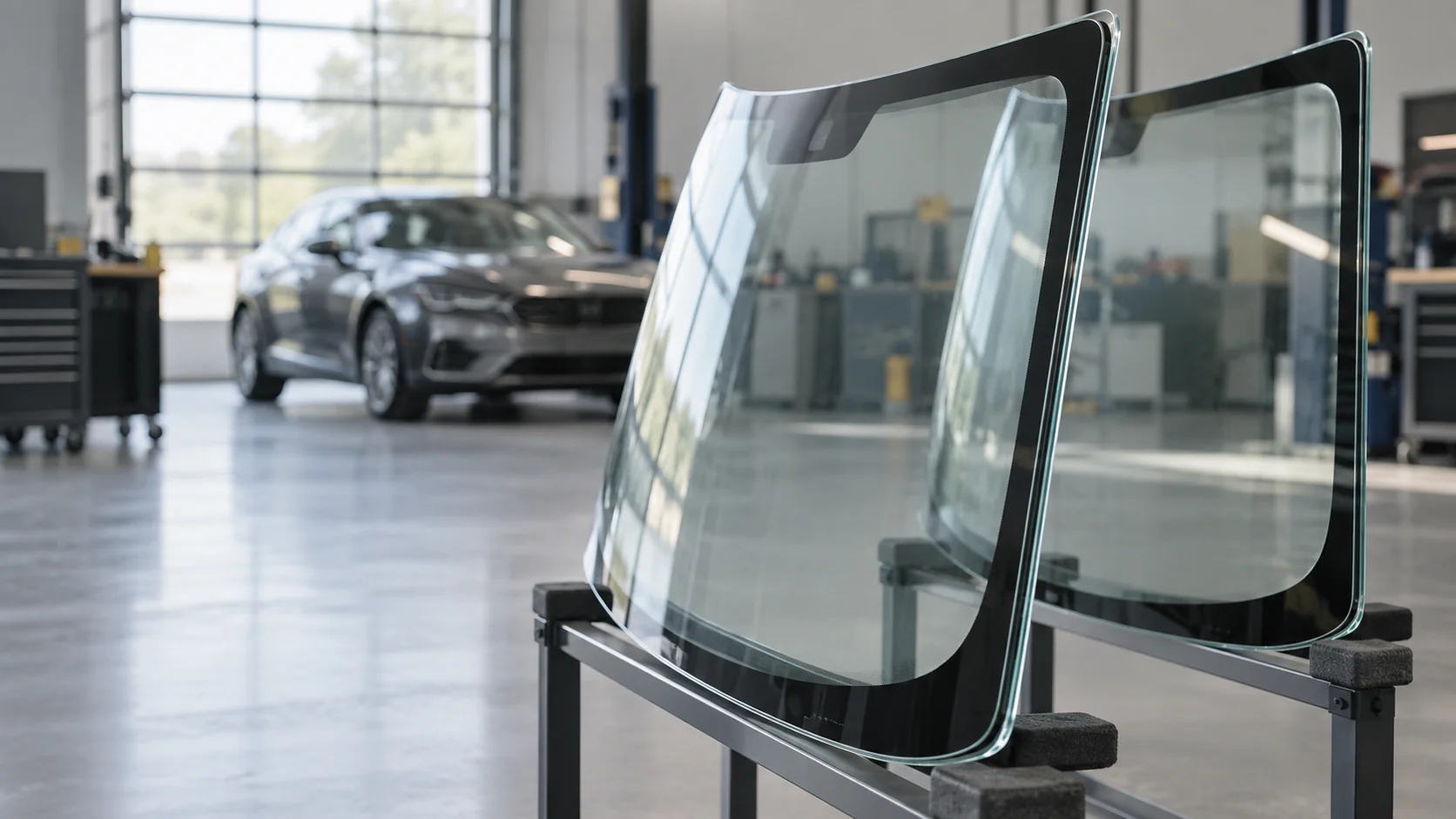
Same safety standard for both
Federal Motor Vehicle Safety Standard 205 covers glazing in cars and trucks, and it states that glazing intended for aftermarket replacement must meet its requirements too. Windshields are marked AS1: NHTSA has explained that glazing meeting the windshield test requirements must be marked AS-1. Illinois adds its own rule: section 12-501 of the Vehicle Code makes it unlawful to knowingly install glazing that is not approved safety glazing.
How to read the mark in the corner
The small print in a lower corner of the glass (installers call it the bug) typically shows:
- AS1: the glass type approved for windshields.
- DOT plus a number: the glass maker's code, assigned by NHTSA. The glass maker certifies compliance itself; NHTSA does not pre-approve glass.
- The glass maker's or vehicle maker's name or logo. A vehicle-maker logo is the usual sign of OEM glass.
Photograph the mark on your current windshield before it is replaced; it helps your technician match the part.
What the labels mean
OEM usually means glass made for the vehicle maker and carrying its logo. OEE (original equipment equivalent) is a trade term for glass made to match the original specifications and sold without the vehicle maker's logo. Aftermarket covers glass made to fit by other manufacturers. OEE and aftermarket are not federal categories.
OEM vs. OEE vs. aftermarket
| Question | OEM | OEE | Aftermarket |
|---|---|---|---|
| Who makes it | A glass supplier to the vehicle maker | A glass maker matching the original | Independent glass makers |
| Logo on the glass | Vehicle maker's logo | Glass maker's mark, no vehicle logo | Glass maker's mark |
| Fit | Made to the maker's drawings | Made to match OEM | Made to fit; check features |
| Camera compatibility | Matches the maker's calibration setup | Check against the VIN | Check against the VIN |
| Insurer approach | Ask whether the policy names OEM glass | Ask how the policy classes it | Ask what the policy pays for |
| Availability | Through the vehicle maker's parts channel | Through glass distributors | Through glass distributors |
Swipe the table sideways to see every column.
When the vehicle maker has a view
Some makers publish position statements. Honda's camera-aiming guide says the replacement windshield must be a Honda genuine windshield. GM's 2023 windshield replacement statement says it does not approve aftermarket or non-genuine glass. Subaru strongly recommends genuine glass on EyeSight cars. These statements are about cars whose camera looks through the glass, where optical quality and bracket position affect calibration.
Features that must match
Whatever the source, the part must match the car's features: camera bracket, rain sensor mount, heated wiper area, acoustic layer, tint band and head-up display. HUD glass is the clearest case: glass maker Pilkington says its HUD windshields use a wedge-shaped inner layer to prevent double images, and Honda warns that a non-HUD windshield on a HUD car can show a double image.
What to ask before you agree
- Who made the glass, and is it OEM, OEE or aftermarket?
- Does it have every feature on the VIN?
- Does the vehicle maker require its own glass for calibration?
- If insurance is paying, which glass does the policy cover?
Then compare the answers with the windshield replacement steps and the ADAS calibration requirements.